
Radiofrequency Ablation (RFA)
Radiofrequency Ablation (RFA) is a minimally invasive procedure designed to reduce or eliminate chronic pain by disrupting the nerves that send pain signals to the brain. Using a small probe, heat is generated through radio waves and applied precisely to nerve tissue, effectively “turning off” the nerve’s ability to transmit pain.
This advanced treatment is most commonly used to manage chronic neck, mid-back, and low back pain associated with arthritis of the facet joints, but it can also be used to treat joint pain in the hips and knees. RFA is ideal for patients who have experienced pain relief from diagnostic medial branch blocks or nerve blocks and are seeking a longer-term solution.
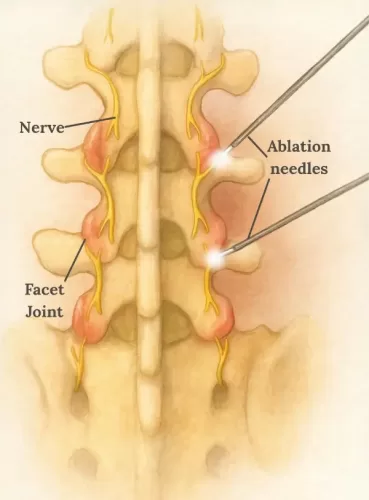
How It Works
The procedure is performed under local anesthesia with image guidance (such as fluoroscopy or ultrasound) to ensure pinpoint accuracy. A thin needle is guided to the area near the targeted nerve, and a specialized electrode is inserted through the needle.
Using radiofrequency energy, the tip of the electrode heats the nerve tissue to a precise temperature. This heat “ablates” or disrupts the nerve’s ability to send pain signals—without damaging surrounding structures.
The procedure typically takes less than an hour, is performed on an outpatient basis, and most patients return to normal activities within a few days.
Conditions We Treat with RFA
- Chronic low back pain due to lumbar facet joint arthritis
- Chronic neck pain due to cervical facet arthropathy
- Thoracic spine pain
- Sacroiliac (SI) joint pain
- Post-traumatic spinal pain
- Hip joint or knee joint pain from osteoarthritis (in select cases)
- Persistent pain after failed back surgery
- Facet joint syndrome
Frequently Asked Questions (FAQs)
What is the difference between a nerve block and RFA?
A nerve block is typically used to diagnose the source of pain or provide temporary relief using anesthetic. RFA is a follow-up procedure that offers longer-term relief by deactivating the nerve responsible for chronic pain.
Is radiofrequency ablation painful?
The procedure involves minimal discomfort. You may feel a warming or pressure sensation during the treatment, but it’s generally well-tolerated under local anesthesia with sedation if needed
How long does the pain relief last?
Relief typically lasts 6–12 months, and in some cases longer. If the nerve regenerates and pain returns, the procedure can be safely repeated.
Will I need to stop my medications before the procedure?
This will depend on your medications. Blood thinners may need to be paused. Your provider will review your full medical history and give you clear instructions before the procedure.
Is RFA a permanent solution?
While it is not considered permanent, it provides extended relief. The treated nerves may eventually regrow, but patients can repeat the procedure if necessary.
Bibliography
Mayo Clinic. (2023). Radiofrequency Ablation for Pain Management. Retrieved from https://www.mayoclinic.org
American Academy of Pain Medicine (AAPM). (2023).
Understanding Radiofrequency Ablation. Retrieved from https://www.painmed.org
National Institute of Neurological Disorders and Stroke (NINDS). (2023).
Chronic Pain Treatments. Retrieved from https://www.ninds.nih.gov