
Low Back Pain (Lumbago)
Low back pain, also known as lumbago, is one of the most common reasons people seek medical care. It can affect anyone at any age and ranges from a dull, persistent ache to sharp, debilitating pain that limits movement. For some, symptoms last a few days; for others, the condition becomes chronic, disrupting work, exercise, and quality of life.
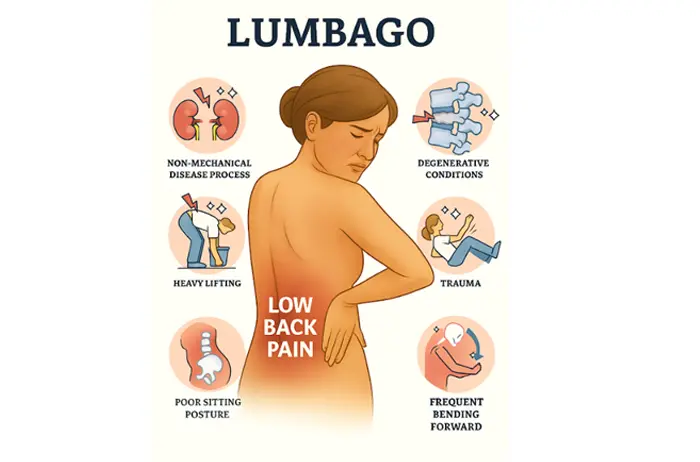
Causes
Low back pain can arise from a variety of structural, mechanical, or inflammatory sources, including:
- Muscle or ligament strain from overuse or improper lifting
- Herniated or bulging discs, which can irritate nearby nerves
- Facet joint arthritis or degenerative changes in the spine
- Sacroiliac (SI) joint dysfunction, causing pain in the lower back and buttocks
- Spinal instability, such as spondylolisthesis or disc degeneration
- Poor posture, obesity, or a sedentary lifestyle
- Trauma or previous injury
Often, low back pain is multifactorial, requiring a thorough evaluation to pinpoint the primary driver.
Commonly Affected
Low back pain can affect people across all age groups, but it is most common in:
- Adults between ages 30 and 60, due to peak work and activity levels
- Individuals with physically demanding jobs or prolonged sitting
- Athletes or active individuals with repetitive strain or sports injuries
- Patients with spinal arthritis, osteoporosis, or disc degeneration
- Pregnant women, due to shifting spinal alignment and weight load
It may present as localized lumbar pain or radiating discomfort into the hips, thighs, or legs (sciatica).
Treatments Available
At AllSpine Pain and Wellness, we use a multi-disciplinary and minimally invasive approach to manage low back pain. Treatment is tailored to each patient’s diagnosis, severity, and goals:
- Epidural Steroid Injections (Lumbar ESI): Reduces inflammation around compressed nerves to relieve radiating leg pain and improve mobility.
- Medial Branch Blocks (MBB) and Radiofrequency Ablation (RFA): Targets the facet joints by disrupting the nerves that send pain signals from arthritic spinal joints.
- Sacroiliac (SI) Joint Injections: Relieves pain stemming from inflammation or dysfunction of the SI joint.
- Percutaneous Discectomy: A minimally invasive procedure that removes part of a herniated disc pressing on a nerve.
Our focus is to restore function, relieve pain, and help patients avoid unnecessary surgery whenever possible.
Frequently Asked Questions (FAQs)
When should I see a doctor for low back pain?
You should seek evaluation if the pain lasts more than a few weeks, is severe or worsening, radiates to your legs, or is associated with numbness, weakness, or bladder changes.
Can back pain be treated without surgery?
Yes. Most cases respond well to conservative and interventional treatments like injections, therapy, and lifestyle changes. Surgery is rarely the first option.
Are epidural injections safe?
Yes. Lumbar ESIs are widely used and considered safe when performed under image guidance by experienced providers. They can provide significant relief when inflammation is the source of pain.
What is radiofrequency ablation and how long does it last?
RFA uses heat to disable nerves transmitting pain from arthritic joints. Relief typically lasts 6–12 months or longer, and the procedure can be repeated if symptoms return.
Will I need imaging like MRI or X-ray?
In most cases, yes. Imaging helps identify disc problems, arthritis, or other structural issues that may not be visible through physical examination alone.
Bibliography
Mayo Clinic. (2023). Low Back Pain. Retrieved from https://www.mayoclinic.org
National Institute of Neurological Disorders and Stroke (NINDS). (2023). Low Back Pain Fact Sheet. Retrieved from https://www.ninds.nih.gov
American Academy of Orthopaedic Surgeons (AAOS). (2023). Understanding Low Back Pain. Retrieved from https://www.aaos.org