
Degenerative Disc Disease (DDD)
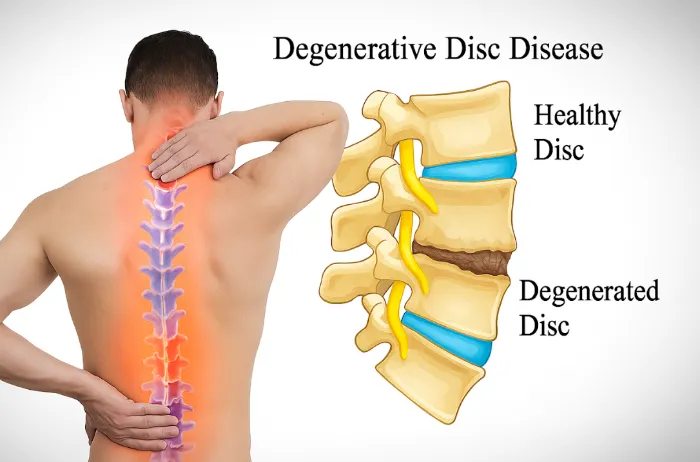
Degenerative disc disease (DDD) is a condition that occurs when the intervertebral discs—the shock-absorbing cushions between the bones of your spine—begin to break down. While this process is a natural part of aging, it can become painful and debilitating when it leads to disc collapse, spinal instability, or nerve compression.
Causes
Degenerative disc disease develops gradually over time and can be influenced by:
- Aging: The discs naturally lose water content and become less flexible as we age.
- Repetitive spinal stress: Overuse from heavy lifting, poor posture, or high-impact activities can accelerate disc wear.
- Disc herniation or trauma: Injury to a disc can lead to faster degeneration.
- Genetics: Some individuals may be predisposed to faster disc deterioration.
- Smoking and poor circulation: These factors can reduce nutrient flow to the discs and impair healing.
As the discs shrink and lose cushioning, they can no longer support the spine effectively, which may lead to pain, stiffness, or nerve irritation.
Commonly Affected
Degenerative disc disease can occur anywhere along the spine, but it most frequently affects:
- The cervical spine (neck) and lumbar spine (lower back)
- Adults over the age of 40
- Individuals with physically demanding jobs or sedentary lifestyles
- Patients with poor posture or prior spinal injuries
- Smokers, who are at higher risk for faster disc degeneration
Symptoms often include persistent back or neck pain, stiffness, limited mobility, and radiating pain if nerves are compressed.
Treatments Available
At AllSpine Pain and Wellness, our treatment plans for DDD are tailored to each patient’s symptoms and spinal condition. We focus on conservative, interventional, and minimally invasive techniques to avoid surgery when possible:
- Epidural Steroid Injections: Reduces inflammation around compressed nerves, easing pain and improving movement.
- Percutaneous Discectomy: A minimally invasive procedure to remove damaged disc tissue that may be irritating nearby nerves.
- Activity Modifications & Ergonomic Education: Supports long-term spinal health through daily habit changes.
Frequently Asked Questions
Is degenerative disc disease actually a disease?
Not exactly. Despite the name, it is a natural aging process rather than a disease. However, when degeneration leads to chronic pain or nerve compression, it becomes a medical issue.
What does DDD feel like?
Symptoms may include chronic low back or neck pain, stiffness, and occasional flare-ups. If nerves are affected, you may also feel radiating pain, numbness, or weakness in the arms or legs.
Will I need surgery?
Most patients do not require surgery. With the right combination of injections, therapy, and lifestyle changes, symptoms can be managed effectively. Surgery is only considered for severe, non-responsive cases.
Can DDD be reversed?
No, the disc changes themselves cannot be reversed. However, with proper treatment, pain and function can be significantly improved.
How long does it take to feel better?
Recovery depends on the severity and the treatment plan. Many patients experience relief within a few weeks of starting care, especially with guided physical therapy and injections.
Bibliography
Mayo Clinic. (2023). Degenerative Disc Disease. Retrieved from https://www.mayoclinic.org
American Academy of Orthopaedic Surgeons (AAOS). (2023). Understanding Disc Degeneration. Retrieved from https://www.aaos.org
National Institute of Neurological Disorders and Stroke (NINDS). (2023). Back Pain Fact Sheet. Retrieved from https://www.ninds.nih.gov